

Wednesday catchup


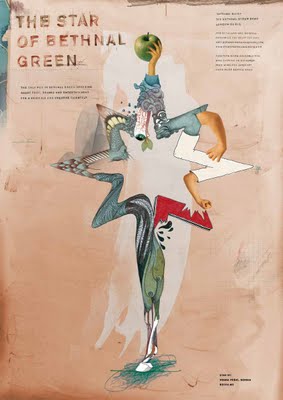
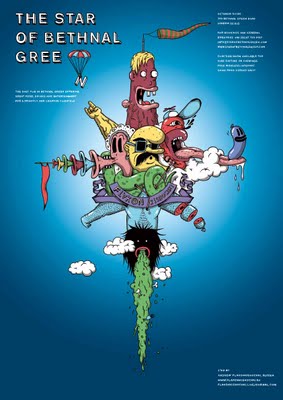
Rapid fire blog entry this morning. Interesting news. I have my work on Behance, a cool creative resource/social networking site...and I got an interesting job (albeit gratis) that came across the email. There is The Star of Bethnel, a pub in East London that has a poster program that they ask international artists/illustrators to submit art for. They have a good deisgn firm doing the branding--and they came across my work on Behance and want me to do the December poster...anything I want. How fun is that...Rob thinks I should go totally Memento Mori on it... I am thinking more a la valentines with Fraktur angels as it is December and the English don't really have an issue with Christmas as the December Holiday.

Work here has been from fire drill to fire drill...the quick, drop everything approach to no planning and trying amidst the chaos to not let anything slip through the cracks. I have been carless for well on to two weeks which is making me a bit of a princess in the tower--- with work, cooking and general house stuff keeping me land locked. Timmy, our painter, spent the better part of Monday getting a small cherry picker into the back yard to paint the roof trim of the house. As I hung up the phone with another rush completed, my mother in law came in to tell me " Timmy is up in the air". What? And I need to be the adult for this too? So, I went outside to see that yes, Timmy was up in the air--with the cherry picker somehow stuck--locked so the mechanism wouldn't work. Everybody was hanging back...and yes, I had to be the adult. So, Timmy and I talked it through...and I tried a few things and managed to get the up/down mechanism unlocked so that we could get him down. Then, it was back to the other emergencies...not as scary as that...but still scary for the two hour turn arounds/bailouts that keep coming.

That is why the star project seems so fun. No emergency there.

Kitty is crazed with her play practices. Alex with Cross Contry training and trying to make up the work he lost last week with his ill days. Rob has left every morning before seven and this morning at five to get to NYC and back today. Its pretty much everyone nose to the grindstone.

This weekend we have a celebrated apple picking/cider pressing event that we have been included in...which should be interesting and fun. But first, we need to get through this week.



The rose is perhaps the most mystical and beautiful of symbols to Rosicrucians. The rose possesses both beauty and pain; one can not have the fragrant blossom without the accompanying thorns. This concept of dual nature pervades the writings of both the Kelpius settlement of 1694 and the Eighteenth-Century Community of the Solitary at Ephrata. At both settlements Rosicrucian symbolism and concerns were part of the organized belief structures of the members. As with the rose, so too in life we must take the good with the bad, the cross with the crown, the dark with the light, the pain with the joy.

A most beautiful and symbolic poem on the rose was written in the mid-eighteenth-century by Conrad Beissel, known as Vater Friedsam, Father Peaceful.

The rose is perhaps the most mystical and beautiful of symbols to Rosicrucians. The rose possesses both beauty and pain; one can not have the fragrant blossom without the accompanying thorns. This concept of dual nature pervades the writings of both the Kelpius settlement of 1694 and the Eighteenth-Century Community of the Solitary at Ephrata. At both settlements Rosicrucian symbolism and concerns were part of the organized belief structures of the members. As with the rose, so too in life we must take the good with the bad, the cross with the crown, the dark with the light, the pain with the joy.

A most beautiful and symbolic poem on the rose was written in the mid-eighteenth-century by Conrad Beissel, known as Vater Friedsam, Father Peaceful.

From Lucy Carroll's article on the Symbolism in Conrad Beissel's hymn

Changing of the old guard?


“To say that ‘literate’ and ‘intelligent’ is elitist - that’s insane, the way people sling around ‘arugula’ to be synonymous with highfalutin,’’ says [Laura] Shapiro. “This is another nail in the coffin of literate journalism.’’ from The Mourning After (boston.com)
How sad. I thought with Ruth Reichl at the helm of Gourmet Magazine, there was a chance that this old school magazine could pull through the crash and burn that is going on in print media today. Reichl, an author and realistic food person is an inspiration in her energy and approach to her writing and passion for food, I thought would bring a spirit and splash to this tried and true publication. Granted, I thought that Gourmet was for "grown ups" until I had 6 weeks of being at home with my new baby daughter--sleepless and living in the moment. I found that I loved Gourmet and the New Yorker for their little mental vacations they took me on...and the recipes that I began to cook out of Gourmet were easy, delicious and inspiring me to go further, to crack open more books, to try the untried. It got me through the early days of mom hood and frankly was part of my evolution as a cook for a new little group of eaters.

Since then, Gourmet has been a monthly occasion in my life. Now, it won't be.

Interestingly, in looking around a bit about the demise of Gourmet, I ran into some interesting articles

Gourmet Editor Ruth Reichl: Print Magazines Are Toast
by Henry Blodget on the Business Insider page
Ruthie in Wonderland: Ruth Reichl Reflects on Conde Nast by John Koblin from the New York Observer
Clearing the Table by Deborah Solomon, New York Times

From the Koblin article

“That kind of luxury that we all had [at Conde Nast] is probably a thing of the past. The new business realities have changed the life at Condé Nast. I think print magazines as we know them will cease to exist...

“I do think that there is going to be something that will be very exciting and that will incorporate video, instant shopping,” she said. “I think that the rich experience that is in magazines will likely move to another platform. It won’t be online. It will be what magazines are now, tools for living and inspirational and intellectually rich. I think magazines in that sense won’t be going away.”

As an illustrator, the great publishing industry changes. The magazines and newspapers that were solid clients for articles, book reviews, Sunday supplements and all else are dying. So, where does that leave us, the great great grandchildren of Rockwell and Howard Pyle-- the great illustrators of their time? Where will the painters go? I guess, children's book and advertising, portraiture and gallery work. Holiday cards? A santa or a teddy bear as a client told me..."thats what their Chairman loves" (OY!).

Now, if we look at Will Bradley, he illustrated for publications and then some...Bradley might have made the jump to web design and imagery or even flash animation. There is work there. I mean, if you have the wits and imagination that illustration training should hone, this new media beyond paint, beyond ink on paper has room.

I had the opportunity to work with a client and a consulting company of the development of an e-card for the Holidays. These guys gave us story boards which we didnt approve and immediately launched into a direction we had never even seen...fully developing it in flash with this easy listening "fashion show music box music"--so middle of the road and tacky. I had to pull it back and talk about Tiffany and Company, the "little black dress with pearls" positioning (which in the old days might be associated with class..and today, no one gets it...so the whole "its like this and this and this" gets you there in a less abbreviated way). These guys are computer jocks--not problem solvers.For really good designers or illustrators thinking about the problems, thinking about transitions and messages, about the story and the impresssion is part of their training, their make up , their MO. It was illuminating to work with these functionaries that we essentially had to "move their hands with our own" to get the changes to move it towards good...not even great. But back to the premise...There is work...it just might not be the tradtional "old school" venues that many of us hoped would bloom and blossom for us, but new trees, new orchards where the fruit has yet to be discovered. And picked.

whirl


I am in a miasma of ideas, things to do, things not to do, packages to send, people to call, chores to do, clothes to fold, leftovers to reconfigure. The sublime and the ordinary and somehow I am stuck dead in the middle. A bit stunned, but in the middle. The ideas that are whirling vacillate between the biography I am reading in Julia Child and the informal research I am doing on the German Pietist in Pennsylvania -- their life, their lifestyle, their art, their healing practices, their philosophy...so the middle is an odd place to be. The only similarity that these topics have is that it about people who have strong beliefs and are committed to doing the right thing with those beliefs.

Julia Child was someone who pursued her love of eating to that of cooking to translating that discipline of French cooking for the layman to experience. She introduced measuring and repetition to the processes that were art to the French. She was always drilling down and asking herself if the newly wed wife who was cooking from her book could follow her writing. She refused to dumb down her roast chicken to a mere 24 words (as her competition did)--simplifying but not compromising her beliefs and not giving the editors a "ladies magazine" approach to the cooking she loved and believed in.

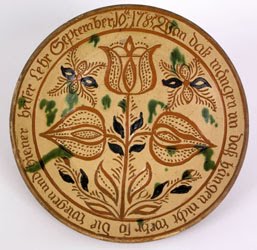
The Pietist....No compromise, all passion...afterall, they were Germans. Everything exuded their belief from their art, to the healing invoking the Virgin or Jesus, to the blessings on their houses. They were not dour in those beliefs. Conrad Beissel (1690-1768), the founder of the Seventh Day Dunkers (another name for the German Baptist Brethren),a hermit and then founder of the semi- monsastic community at Ephrata, wrote hymns galore. (I have found there was a real flourishing of hymn writing in Pennsylvania during this period with the Quakers, Moravians etc. to name a few groups)). His hymns were then embellished and designed within the community and either hand done in a scriptorium at Ephrata (one of the tasks the sisters did) or printed (Ephrata had one of the most significant presses/printing operations at the time...working alongside Ben Franklin who also printed some of Beissel's philosophy tracts). These hymns were embellished with flowers, crowns, birds, angels/spirit guides, hex marks, little faces, sometimes unicorns, sometimes lions. All in brilliant red, yellow, blue, brown and black. The same color palette and spirit we see, not in the spaces at Ephrata, but in the Peter Wentz Farmstead with the brilliant yellow walls and bright blue built in cabinetry. And the enormous black polkadots adorming those bright yellow walls. Nothing dour there.
---
Alex has pink eye and at the doctors as we speak. Kitty still sleeps (I am going to wake her up as there is work to be done). Rob and I are making lists of things to be done in town and here from bulb planting to spackling and sanding walls. I think th ere is lots of work to be done...and my time here is needed elsewhere.

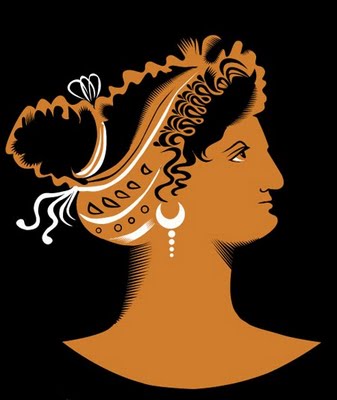
ps. The images of Penelope and the Gorgon I posted yesterday are sketches for a theatre poster for a future Hangar production....

Society of Woman in the Wilderness.

From Ephrata, Hotbed of Religion>>

Quite as curious as the experiment at Ephrata was the earlier colony on the Wissahickon, the Contented of the God-Loving Soul. This was better known as the Society of the Woman in the Wilderness because of its belief that the Woman in the Wilderness, mentioned in Revelation 12:14- 17 , foretold the second coming of Christ. Led by Johannes Kelpius, a mystic of the University of Altdorf, the Contented of the God-Loving Soul reached Bohemia Landing on the Chesapeake on the 12th of June, 1694. Clothed in coarse pilgrim garb or in the dress of German university students, they struck out for Philadelphia, arriving there the 23rd. That night, only a short way out of Penn's new city, they built a bonfire on a hill to celebrate Midsummer Night's Eve and scattered the burning brands down the hillside. The next morning they went on to Germantown, there to await the millennium. On the Ridge, a wooded hill above the Wissahickon, they built a log structure forty feet square, with a large room to serve as a chapel and small cells as bedrooms for the brethren. On the top of the building was an observatory equipped with a telescope or perspective glass. There each night one of the brethren watched the heavens for some celestial sign of the Bridegroom's coming "that their lamps might be trimmed and burning." Near-by, in a small cave to which he could retire and meditate, Kelpius set up his hermitage. In a small clearing by the monastery they planted a garden of medicinal herbs, possibly the first botanical garden in America.

Theirs was a monastic settlement; the brethren took vows of celibacy. Many of the votaries were learned men who had been driven from the German universities because of their unorthodox religious views. A smell of alchemy hung about this colony in which horoscopes were cast and the use of the divining rod was not unknown. When the year 1700 came and went, and the millennium on which they had counted did not take place, some of the brethren lost heart. Yet the following year they felt for a short time that their hopes were about to be realized. In this particular year they attached great importance to their celebration of Midsummer Night's Eve because it was their seventh Midsummer Night's Eve in America. According to a legend recorded later at Ephrata, the brethren saw a vague white moving figure in the air just as they were about to light their fire. As it came closer to them they saw that it was an angel, gloriously fair. Receding for a moment into the deep shadows of the hemlocks that towered above, it reappeared so that again they were able to see that it was an angel, "the fairest of the lovely," before it melted away into the forest. The enthralled votaries fell to their knees, feeling certain that the Heavenly Bridegroom was about to appear. Prayers were held until midnight, when the fires were lighted. Then with incantations the brethren flung the fiery embers down the hill. Throughout the rest of the night the brethren prayed. On the third night the apparition was seen once more and then it vanished forever. After this the brethren lost hope, and the community began to diminish until Kelpius's death in 1708 at the early age of thirty-five brought it to an end. Kelpius was buried in the garden at sunset to the chanting of De Profundis. As his body was lowered into the grave there was let loose a white dove that flew to the heavens and vanished over the hemlocks. Within a few years the abandoned monastery fell into ruins. Today the Society of the Woman in the Wilderness is only a memory.


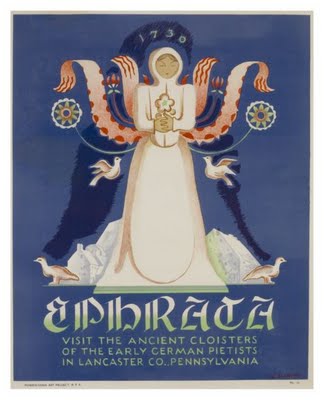
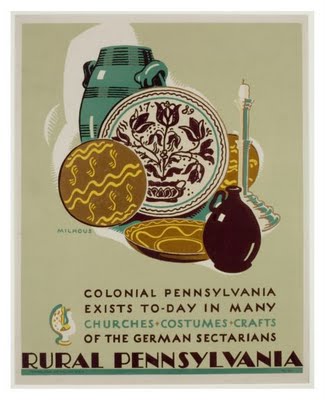
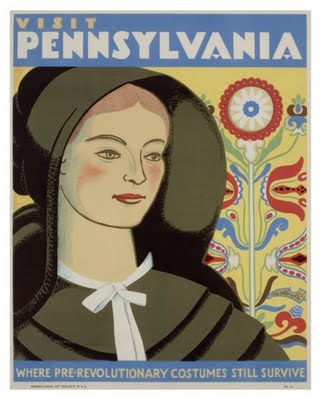
WPA posters from Katherine Milhous courtesy of WPA Posters which links to the Library of Congress WPA Archive (!)

To Win at Every Game One Engages In
Tie the heart of a bat with a red silken string to the right arm, and you will win every game at cards you play.
Long Lost Friend,(Der Lange Verborgene Freund)by Johann Georg Hohman,
published first in Pennsylvania in 1820

We have bats behind the shutters of the Camp House-- so the temptation to wear them on my arm is huge as Pat the Bugman (our exterminator) says there is no way to get the bats when they are happily hiding there. No way to trap them, no way to shoo them away.
So, in the tradition of the Pennsylvania Germans, we can tie their hearts to our arms with a red string. Just like the Kabala, the Powwowers love red string.

I was reading a bit on Conrad Beissel and his poetry, particularly the hymn about roses linking a year of a rose to the year of the Solitary within the Ephrata Cloister and am working out a little rosy picture to go with it. However after reading this very detailled description of Ephrata, it's traditions and lifestyles: Ephrata, Hotbed of Religion>> it is far more severe and less rosy than my fantasy picture I drew today...However, the reality is far more severe and interesting than I could have ever imagined. Fabulous...and worth our talking about tomorrow. Its late and the day has gotten away from me.
.
Alex is on day two of the flu--but is better. Kitty is busy with plays and work. Rob is busy with the Ennion Society meeting/dinner and the Seminar on Glass this week...and I am just slugging away.

Personal Powwowing


I was reading more of David Kriebel's article on powwowing among the Pennsylvania Germans last night. He breaks the practice of powwowing down into 3 groups from small, insignificant treatments to the big bam boom treatments with all sorts of laying on of hands, remedies and prayer. Along with this, he breaks the practitioners of this folk medicine down into those neighbor or family friends or members to professionals who accept payment and have a space devoted to the practice. Kriebel is good not to condemn or even personally comment on his understanding of this and is open to the efficacy of these practices. He cites folks even now practicing powwowing in Pennsylvania...a tradition that is always passed down from father to daughter, mother to son, husband to wife, brother to sister...but never same sex.

From Wikipedia:

CURE FOR THE HEADACHE

Tame thou flesh and bone, like Christ in Paradise; and you who will assist thee, this I tell thee (name) for your repentance sake. + + + This you must say three times, each time lasting for three minutes, and your headache will soon cease. But if your headache is caused by strong drink, or otherwise will not leave you soon, then you must repeat these words every minute. This, however, is not necessary in regard to headache.

TO REMOVE BRUISES AND PAINS

Bruise, thou shalt not heat;
Bruise, thou shalt not sweat;
Bruise, thou shalt not run,

Pow-wow is a system of American folk religion and magic associated with the Pennsylvania Dutch. Its name comes from the book Pow-wows, or, The Long Lost Friend, written by John George Hohman and first published in German as Der Lange Verborgene Freund in 1820. Despite the Native name, taken from an Algonquian word for a gathering of medicine men, the collection is actually a very traditional collection of European magic spells, recipes, and folk remedies, of a type familiar to students of folklore. They mix prayers, magic words, and simple rituals to cure simple domestic ailments and rural troubles.

The tradition is also called hex or hex work, or Speilwerk in Pennsylvania Dutch; its adepts are hexenmeisters. The tradition of Hex signs painted on Pennsylvania barns in some areas originally relates to this tradition, as the symbols were pentagrams thought to have talismanic properties; though many current hex signs are made simply for decoration.

Also important to the pow-wow practitioner were the Sixth and Seventh Books of Moses, books brought to the United States from Germany, containing cabalistic magic, claiming to be the magical arts by which Moses obtained his powers and commanded spirits. Actually, the Sixth and Seventh Books of Moses were apparently compiled by Johann Scheible in nineteenth century Germany.

Another characteristic practice of pow-wow magic is the Himmelsbrief or "heaven's letter" and Teufelsbrief, a "devil's letter," which presumably is meant to bestow a curse. Significantly, the Long Lost Friend assures its owner that:

Whoever carries this book with him, is safe from all his enemies, visible or invisible; and whoever has this book with him cannot die without the holy corpse of Jesus Christ, nor drowned in any water, nor burn up in any fire, nor can any unjust sentence be passed upon him. So help me.
No more than Virgin Mary shall bring forth another son. + + +

From the sublime to my reality: Alex woke up this a.m. with a sore throat, phlem and of course a raging fever. Guess I will need to get my red string ready and see if i can help him...either that or a thermometer and ibuprophen. I think the latter probably will be more effective for me. However, I do need to look into the Himmelsbrief (we've talked about this), and the lovely devil's letter. Plus, the Books of Moses Long Lost Friend are a must. There might be some pictures there! Who knows, maybe a remedy too?

From the Long Lost Friend:

A SURE WAY OF CATCHING FISH.

Take rose seed and mustard seed, and the foot of a weasel, and hang these in a net, and the fish will certainly collect there.

Sunday redux


I apologize for being so silent. It just been too much with the work at hand (endless variations on a similar thing to finally get to the end, plus new stuff with 2-3 hour turn arounds that can really be trying). It really is quite a bit to stay on top of that pony, blog and just get the day to day resolved. I will try to be more communicative this week.
Yesterday (and I will post the pictures later) we visited Durand's Forge, the blacksmith shop and world of Durand Van Doren, an amazing artist, clever and funny person, generous host and remarkable blacksmith. He works outside of Mecklenburg in a few small buildings heated by big woodstoves, with his work, his collections, his inspirations all nailed to the wall or arranged in little story telling vignettes that depict an active brain, a wit and humor that goes with the work. He showed us gates and benches he had done on commission along with enormous groups of chandeliers and lighting for Cornell and other big institutions. But he also had a wrought iron Kissing Booth and Good Luck Bench (made from horseshoes)... There was a lovely named dog house for his little confident Jack Russell, Mick--along with all sorts of personal totems posted on the wall around Mick's abode. Duran had mini forges in the yard to the back of the shop where he teaches blacksmithing...all sorts of machines made of this and that to create small approachable forges. He had a pot of beef stew going on one of them...and kindly offered us this hospitality along with his stories and ideas. He had all sorts of fruit trees (which Kitty identified confidently, thanks to the kindness of Ian and Jackie Merwin's tutorial)) and a real live chestnut (not horse) tree with it's nuts standing proud in the spiky shells.


Durand is a man of many talents. He is a big Trumansburg Rotarian..a giver and there at the chicken barbeques, the golf events, the races, the meetings. He always gives when people need things for auctions and raffles. He also is one of the refs at our only Pro Sport in Ithaca, rollerderby with the SufferJets. He is a remarkable artist--and his world at the studio invites you into his thinking, ideas, and life. If you have a chance, or just an hour, I highly recommend you visit Durand next weekend during the second weekend of Ithaca Art Trail.

We then, visited friends in the Cayutaville area. They have recently built a studio/ house compound--with lovely porches springing off each level to overlook a spectacular valley (which yesterday with the Fall colors was dumbfoundingly beautiful). Their work space was great, and their living space, equally so...with vibrant color on the wall--unexpectedly wonderful, and the beautiful cabinetry and woodwork creating a very happy place to spend all your days. They have a wonderful, happy garden with an enclosure as happy as the parsley framed walkways, energetic nasturtium, a pineapple sage...all poetry...abutting the most perfect chicken coop with tailored black chickens happily chasing each other down one end of their run and back again. Shady Grove was with her best dog girlfriend...and enchanted by the chickens. She didnt know what to make of them. We were so honored to have a chance to visit these lovely kind people in their paradise as well. And, on such a beautiful day--with the evening sky moving from blue to purple with red edges in the sky, to shimmering gold trees. Breathtaking.

And to cap it off, we went to see Julie and Julia at Cinemopolis. Bliss..and a gumdrop to finish a wonderful day of seeing and meeting, color and light, ideas and brilliant work. What a blessing we have .


Click for englargement>>

more work


This monkey head is part of an illustration series in the works. Just to give you a looksee at the process.

Singing in Pennsylvania


detail from:
Hand-drawn; hand-colored; hand-lettered. This fraktur consists is leaf 18 (verso of 18/recto of 19) in a music book that was produced at Ephrata Cloister. On the left are the opening lines of three hymns with music. On the right are music and a drawing of flowers. The book consists of three preliminary leaves, one hundred and forty-one numbered leaves (out of an original one hundred and sixty), one unnumbered leaf, and the printed index of opening lines of the hymns in four unnumbered leaves. The music includes music in four parts and the opening words to a selection of hymns from the Zionitischer Weyrauchs Hügel (The Incense Hill of Zion), published in 1739 by Christoph Saur of Germantown. There is major decoration on the rectos of leaves numbered 19, 24, 30, 38, 58, 61, 88, 90 and 122. Minor decorations can be found throughout the book. Three additional leaves, including verso of 60/recto of 61, verso of 89/recto of 90 and verso of 120/recto of 121, are included in the database as FLP 114702, 114703 and 114704. Courtesy of the Free Library of Philadelphia.

Was doing some research on Conrad Beissel, the founder of the Ephrata Community (a lodestone in my understanding of a particular driver/style setter in the Fraktur style). Beissel came to the US from Germany as part of the Community of the Brethren--and split off to found Ephrata, a monastic community with a sisterhood and brotherhood. Beissel wrote hymns and encouraged his followers to sing, and sing purely--as their celibacy, they believed, was manifested in the purity of their voices. Chasing down a bit on Beissel's hymns, there was a firestorm of hymn writing in Pennsylvania at that time happening in all corners of the state from the Ephrata Community to the Moravians in Bethlehem (see the Google book, The Early Hymn Writers of Pennsylvania by Lucy Carroll. Coupled with this writing, Beissel encouraged his followers to illuminate and illustrate hymnals which went beyond the walls.

The Ephrata community was known for it's printing...and shared work with, yes, Benjamin Franklin. So, the link is made between the two. Franklin was tuned into what they were doing technically and I would assume, intellectually. From Black Arts, The History of Printing in Lancaster County:

1730s: In Philadelphia, Ben prints several mysteriously mystical books for the Ephrata Cloister, including:

* Mystische Und sehr geheyme Sprueche (Mystical and Very Secret Sayings) (1730) --- Authored by Conrad Beissel to explain his other-worldy views on Christianity, celibacy, and spiritual androgyny.
* Goettliche Liebes und Lobes gethoene Welche (1730) (Melodies of Love and Praise) --- This is a hymnbook of 65 hymns written by Conrad Beissel and other Cloister poets.
* Vorspiel de Neuen-Welt (1732) (Prelude to the New World) --- This is sort-of Beissel's New World Symphony. It's a hymnbook, with more mystical hymns by Beissel and friends.
* Jacobs Kampff- und Ritter-Platz (1736) (Jacob's Place of Struggle and Elevation) --- More ethereal hymns by Conrad Beissel. This book's preface includes the earliest printed mention of the name Ephrata: Ephrata in der gegend Canestoges (Ephrata in the Conestoga Region.)

From Benjamin Franklin, In His Own Words:

"Founder of the German Seventh-Day Baptists Johann Conrad Beissel immigrated with the community to Ephrata, Pennsylvania, in 1732. Beissel served as the spiritual director of the group as well as its composer, devising his own system of composition. The group's illuminated musical manuscripts were hand-lettered in Fraktur and are among the earliest original music composed in the British colonies. This illustrated hymnal was once in the possession of Benjamin Franklin. The rare second compilation of Beissel's hymns was printed in roman type without music by Benjamin Franklin in 1732."

Link to see a page of this hymnal> another>>Beissel"s writings>


Click to enlarge>> nose needs to be revisited. the abbreviation of the body> same.